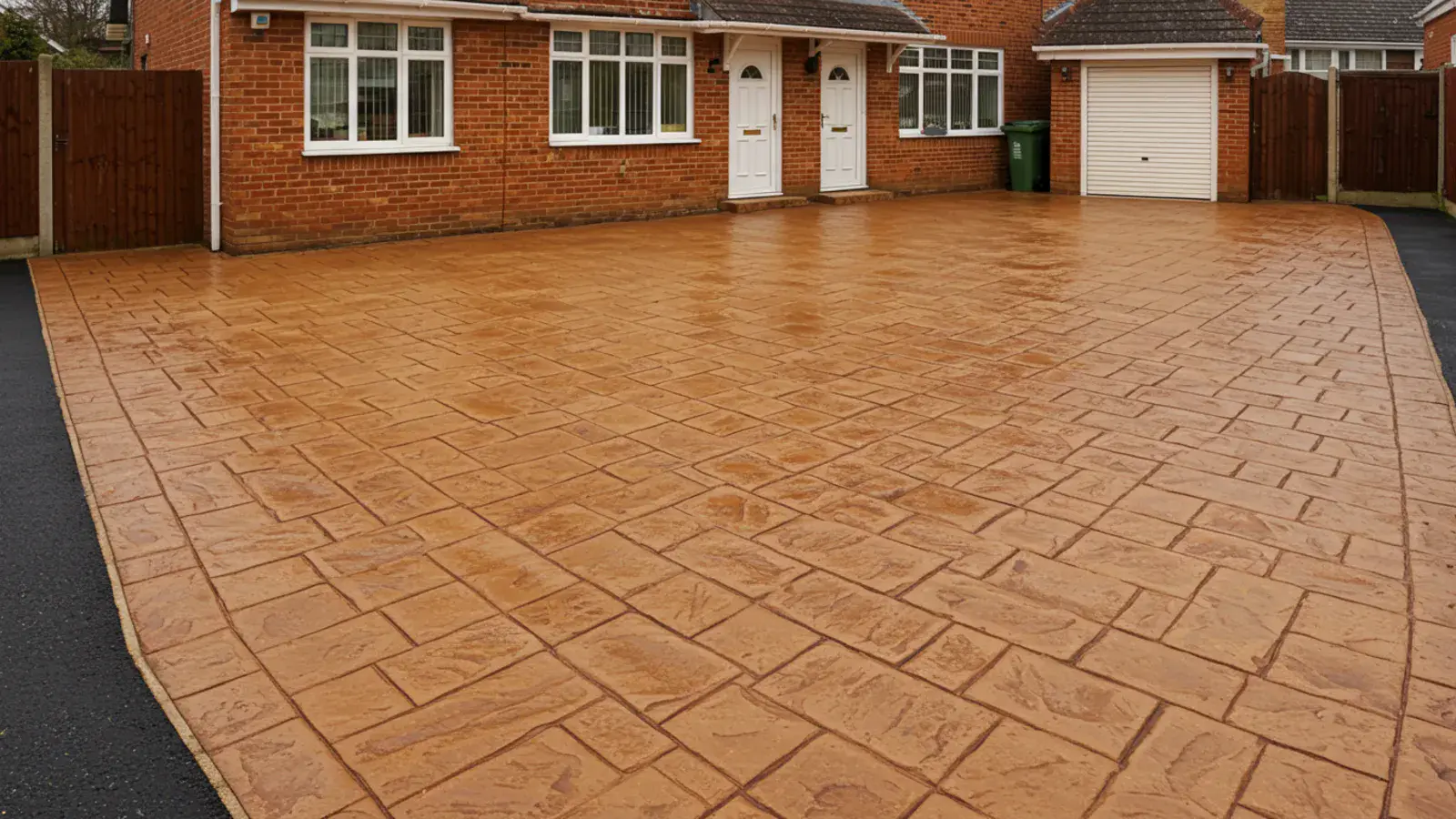
Imprinted concrete restoration in Stanley
Cleaning, resealing and recolouring for wide, open imprinted concrete drives across WF3, including Outwood, Lofthouse, Bottomboat and Newton Hill.
Get a free Stanley quoteBetween Wakefield and Leeds, Stanley is a place of open frontages and a lot of sky. That is good news if you like a spacious drive, and the reason imprinted concrete here ages differently from the town streets nearby. In Stanley it is the sun, rather than the damp, that tends to do the damage first.
Room to park and room to fade
Stanley, Outwood, Lofthouse and Newton Hill are largely postwar and modern estate housing, and the drives that go with it are generous: two or three cars wide, with an open frontage rather than a shaded alley. Many of those drives were put down as imprinted concrete in the decades from the 1980s onwards, as the surface became popular.
Wide drives in the open expose a lot of surface to the sky. That helps them dry out quickly after rain, which is why moss shows less often here than in a shaded terrace, but it also exposes the sealer to ultraviolet light and the surface to weather from every direction. Our guide to why imprinted concrete fades explains the mechanism and the test that tells you whether the colour has actually gone.
Sun side, shade side
On a big open frontage the surface rarely weathers evenly. The part nearest the road and the parts that face south take full sun for much of the day. Under a porch, against a garage door or along a high wall is a different story. Over a few years you get a visible tideline, where one half of the drive looks bright and the other pale and powdery.
That tideline is useful. The pale zone tells you the sealer there has gone, and the brighter zone shows what the finished surface should look like. We treat it as a colour reference, clean the whole drive evenly and reseal the lot, so the difference disappears rather than being highlighted by a patch repair. If the pale zone stays pale when it is wet, the colour hardener has worn through and recolouring is needed. Our piece on what resealing costs sets out how that changes the job.
Joints, big slabs and where cracks appear
A wide slab is cut into bays, and the lines between bays are there on purpose to allow for movement. On a large drive those lines carry a lot of the stress, and they are also where water enters first once the sealer has failed. A crack that follows a joint is normal. One that runs across a bay, or steps in height, is not. Our guide to which cracks in imprinted concrete matter will help you tell them apart.
When we reseal, we fill what needs filling and seal the joints so water cannot soak into the edges of each bay.
Vehicles, oil and the big open space
Space for cars means space for work vehicles as well, and a drive with a van or a caravan parked on it for years gets oil stains, tyre scuffing and a dead rectangle where nothing has seen daylight. Oil sits in the pores of unsealed concrete, and it responds to cleaning far better when it is treated before it has been there for years. We deal with what we can and tell you honestly what will remain.
A well-sealed drive is also easier to maintain. A resealed surface is easier to keep clean without repeated hard pressure washing, which is what wears the colour layer and leads to recolouring. How often to reseal explains the three-to-five year pattern, and open sunny drives like these are nearer the three.
How the work goes in Stanley
Open sunny drives dry fast, which is a real advantage on sealing day. The best time of year to seal covers temperature as well as dryness, and a sunny, sheltered site gives us more usable days than most. We clean, then seal, adding recolouring where the colour is gone. Restoration and protection describes the whole job.
Stanley sits just up the road from Wakefield, where we are based, and Leeds is the next stop north. Our Normanton page covers the lower-lying ground to the east. Assessments in Stanley are free, with no obligation.
Stanley and Lofthouse FAQs
- Which areas of Stanley do you cover?
- Stanley and the WF3 postcode, including Outwood, Lofthouse, Bottomboat and Newton Hill.
- Why is the part of my drive nearest the house paler than the rest?
- Sun and shade fall differently across a wide drive. The side that catches direct sun all day loses sealer and colour first. The part under the eaves or beside a wall is protected and keeps its colour. A reseal across the whole surface evens it out.
- Does a large drive take much longer?
- A bigger surface takes more time to clean and seal, and the cleaning always needs to finish well before the sealer goes on. The drying time is the same whatever the size. We will talk through the sequence at the assessment.
The services Stanley drives use
Concrete Cleaning & Pressure Washing
Controlled pressure washing removes dirt, algae, moss and staining — safely restoring pattern imprinted concrete surfaces.
Stanley concrete cleaning & pressure washingConcrete Clear Sealing
Enhance colour and protect your surface with a clear seal — preventing fading, staining and water damage.
Stanley concrete clear sealingConcrete Recolouring
Restore heavily faded or worn concrete with full recolouring, delivering a consistent, like-new finish.
Stanley concrete recolouringConcrete Restoration & Protection
Complete restoration combining cleaning, sealing and protection to extend lifespan and improve appearance.
Stanley concrete restoration & protectionA big, bright drive that has lost its colour
Open frontages show fading first. Book a free assessment and we will tell you whether yours needs a clean, a reseal or a recolour.
Request your free quote