Cracks in imprinted concrete: which ones matter
6 min read Concrete Revive
Not every crack is a problem — some are deliberately cut in at installation. The ones that matter follow a different pattern, and telling them apart saves a lot of worry.
Concrete cracks. It is a rigid material poured in large continuous areas over ground that moves, and a certain amount of cracking is designed into the system rather than being a failure of it. The useful skill is telling the expected cracks from the ones that mean something.
The cracks that were meant to happen
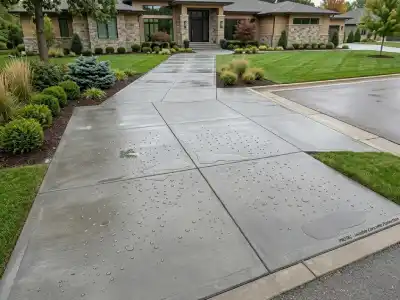
Look for straight, deliberate-looking lines that ignore the stamped pattern — often running wall to wall, sometimes saw-cut, sometimes tooled in when the slab was wet. These are crack-control joints, and they exist precisely so the slab cracks where the installer chose rather than randomly across the middle.
If a hairline crack has appeared along one of these lines, the joint has done its job. That is not damage. It wants sealing to keep water out, and nothing more.
The cracks worth attention
Fine random surface cracking
Thin, shallow lines wandering across the surface without following the pattern. Usually shrinkage from the slab drying too fast when it was poured, or surface-level wear. Largely cosmetic, but they are a route for water, so they should be filled and sealed rather than left open through a winter.
A single wide crack across the slab
A crack you can get a fingernail into, running across the drive and ignoring any control joint, means the slab has moved. Common causes are ground settlement beneath, tree roots, or a control joint that was cut too shallow or spaced too far apart to do its job.
Check whether the two sides sit level. If one side is proud of the other, the ground beneath is moving and that needs addressing before any surface work.
Cracking around a specific point
Radiating from a manhole, a drain or a corner. Usually a stress concentration at that detail. Worth watching but often stable.
Crazed or map cracking
A fine network like crackle glaze over an area. This is surface-level, caused by the finishing conditions when the slab was laid. It looks alarming and is usually harmless, though it holds dirt and can look worse than it is once the sealer has gone.
The one that is genuinely bad news
If a section sounds hollow when you tap it, or feels like it gives underfoot, the slab has lost support from below. That is not a crack problem, it is a base problem, and no filler or sealer addresses it. That section needs breaking out and relaying.
What can actually be done
Fine cracks are cleaned out, filled with a flexible repair compound colour-matched as closely as the surface allows, and sealed over. Done properly on a drive that is then resealed, they become genuinely hard to spot — the reseal evens out the appearance.
What nobody can do is make a crack invisible. Imprinted concrete is a continuous coloured surface, and a repair is a repair. Anyone promising an undetectable result is overselling. Recolouring the whole surface afterwards gets closest, because the new colour coat runs across the repair as well.
The reason to act
Cracks matter mostly because of what they let in. Water enters, freezes, expands, and works the crack wider — and once it reaches the base, you move from a surface repair to a structural one. A crack sealed this autumn is a small job. The same crack after three winters of freeze-thaw often is not.
Common questions
- Are cracks in imprinted concrete normal?
- Some are. Control joints are cut in deliberately so the slab cracks where the installer chose. Fine shrinkage cracking is also common and largely cosmetic.
- Can cracks be repaired invisibly?
- No. They can be filled, colour-matched and sealed so they are hard to spot, and a full recolour gets closest, but a repair on a continuous coloured surface is never truly invisible.
- When is a crack serious?
- When the two sides sit at different heights, or the area sounds hollow or feels soft underfoot. That means the slab has lost support and needs relaying rather than filling.