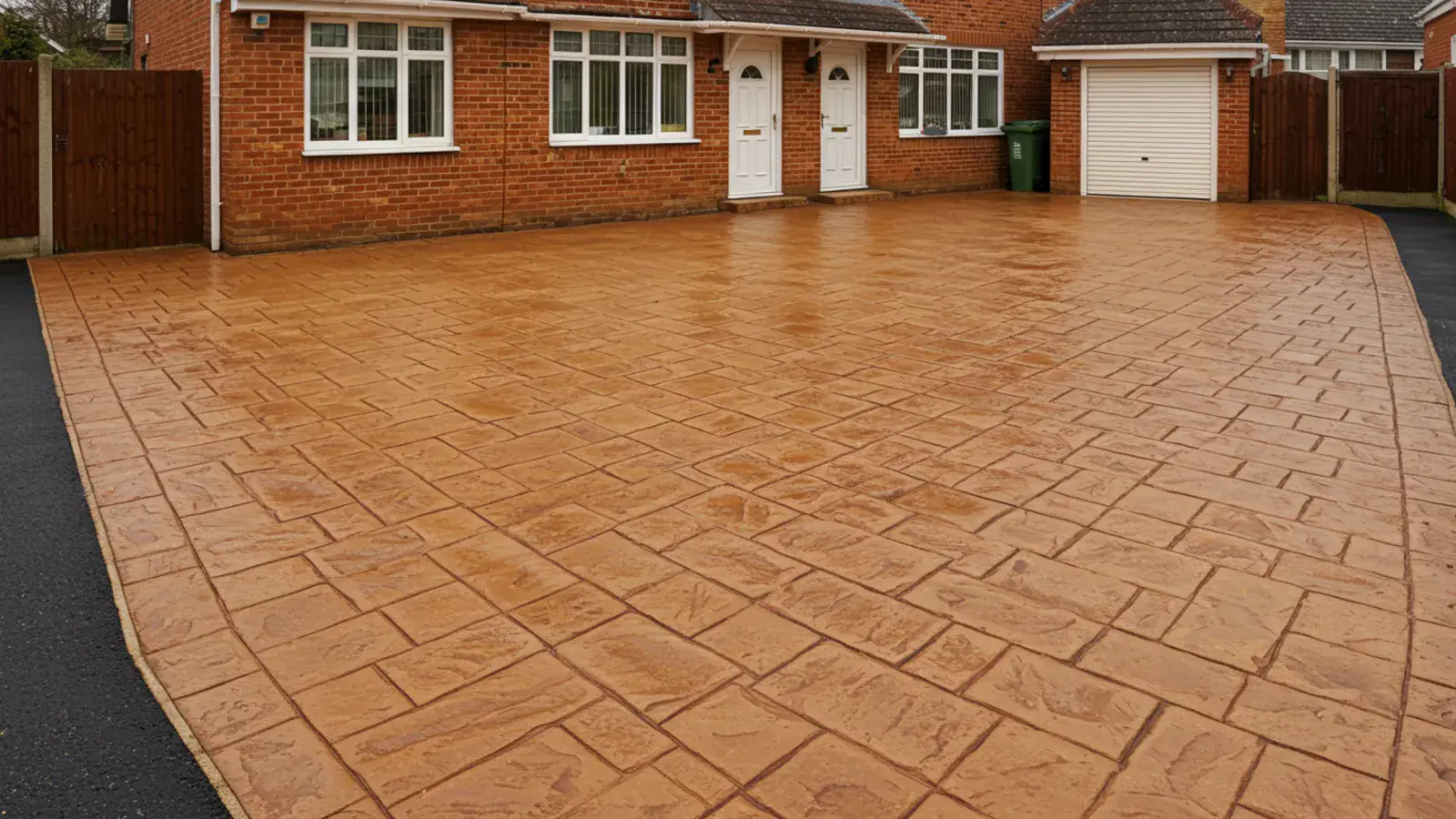
Imprinted concrete cleaning and resealing in Castleford
Restoring imprinted concrete drives across WF10, from Glasshoughton and Whitwood to Airedale and Ferry Fryston, on ground that sits low and stays wet.
Get a free Castleford quoteCastleford is built where the River Calder runs into the River Aire, and it shows in the shape of the place. Most of the town sits on low, level ground close to the water, with very little of the steep fall you find a few miles west in the Calder valley. For a hard surface in a front garden that matters more than almost anything else about the town.
Three waves of housing, one flat valley floor
It is also a town whose housing was laid down in distinct waves. There is the older core of terraces near the centre, the planned estates that went up after the war, and the later development at places like Glasshoughton. Each wave tends to have its own style of frontage, and the imprinted concrete we see here is mostly on the later two.
What flat ground does to a sealed surface
On a sloping drive, water leaves. On a flat one it lingers. A drive that falls only a few millimetres towards the road, or towards a gully that has silted up, will hold a thin film of water after every shower, and that film is what the sealer has to cope with day after day.
Sealer that is permanently damp loses adhesion at the edges first, then lifts in small patches. You see it as a milky or whitish cast that does not rinse off, usually along the lowest line of the drive. It is easy to mistake for fading, and it is a different problem: the colour is still there, but the coating over it has let water in. Our guide to peeling and flaking imprinted concrete explains how to tell the two apart.
Flat ground also means the damp is slow to burn off. A shaded strip beside a fence or a house wall can stay green through most of the winter, and once algae is established on a damp, level surface it comes back quickly after a clean unless the cause is dealt with.
Glass, coal and the estates that followed
Castleford grew on coal and on glass. Glasshoughton's name is a reminder of the glassmaking trade, and the town's post-war estates, Airedale among them, were built to house a growing population. Many homes from those years have since been bought, extended and given new drives, which is where a good share of the town's imprinted concrete comes from.
The estates around Whitwood and Ferry Fryston are later housing, with a driveway to many of the houses. Where a frontage is open and gets a lot of light, UV fading and wheel-track wear tend to show before organic growth does. On the older streets nearer the centre the pattern is the opposite: tighter plots, walls and hedges, and damp that never quite leaves.
What we check before we seal
The first thing we look at on a Castleford drive is the fall. If we can see water sitting, or a dark band along the lowest edge, we want to know where it is meant to go before we put anything new on top of it. Sealing over a surface that is still holding moisture traps the problem under a coating that cannot do its job.
After that it is the usual sequence of cleaning, then the decision between a reseal and something more. If the colour has gone patchy where water has stood, recolouring may be the honest answer. Where the surface is sound and only the sealer has failed, a clean and reseal through our restoration and protection service is the sensible job, and what resealing costs sets out what moves the price. Assessments are free and there is no obligation.
Nearby pages on this site include Pontefract, Normanton, Stanley and Wakefield. Assessments in Castleford are free and there is no obligation.
Castleford drive questions
- Why does my Castleford drive stay damp for days after rain?
- Level ground is the usual cause. If the surface has very little fall, or the drain at the low end is partly blocked, a thin film of water sits on it and dries slowly, especially where fences or walls cast shade. Cleaning back to the surface and checking where the water is meant to go is the first step.
- Is the white, cloudy look on my drive fading or something else?
- Often it is the sealer, not the colour. A cloudy or milky cast that stays when the drive is dry is usually moisture trapped under a coating that has lost adhesion. Faded colour looks pale and chalky but comes back when the surface is wet.
- Do you cover Glasshoughton, Whitwood and the Airedale area?
- Yes. We cover Castleford and the WF10 postcode, with Glasshoughton, Whitwood, Airedale, Ferry Fryston, Cutsyke and Smawthorne included.
Our services for Castleford drives
Concrete Cleaning & Pressure Washing
Controlled pressure washing removes dirt, algae, moss and staining — safely restoring pattern imprinted concrete surfaces.
Castleford concrete cleaning & pressure washingConcrete Clear Sealing
Enhance colour and protect your surface with a clear seal — preventing fading, staining and water damage.
Castleford concrete clear sealingConcrete Recolouring
Restore heavily faded or worn concrete with full recolouring, delivering a consistent, like-new finish.
Castleford concrete recolouringConcrete Restoration & Protection
Complete restoration combining cleaning, sealing and protection to extend lifespan and improve appearance.
Castleford concrete restoration & protectionFlat ground, wet surface
On level Castleford drives the question is almost always where the water goes. Ask for a free assessment and we will tell you what yours needs.
Request your free quote