Peeling, flaking or scaling imprinted concrete: what is actually coming off
7 min read Concrete Revive
When something is lifting off an imprinted drive, the first question is what. A peeling sealer is a routine job. A scaling slab surface is not, and the two are mistaken for each other all the time.
Peeling, flaking, scaling, delaminating. Owners use all four words for the same alarming sight: something is coming up off the drive. They are not the same problem. Four different layers can lift, and which one it is decides whether this is a routine job or a repair conversation.
The layers, top to bottom
An imprinted drive is a stack, and each layer fails in its own way.
- The sealer — a thin acrylic film on top. Sacrificial by design.
- The colour — dry shake hardener and release agent, in the top few millimetres of the slab.
- The slab surface — the thin skin of cement paste that finished the pour.
- The slab itself — the structural body underneath.
Only the first is meant to come off. The rest are the drive.
What is it that you are looking at?
Thin, clear or milky flakes, curling at the edges
These look like dried paint or PVA, and that is close to what they are. This is the sealer letting go of the surface. It happens when sealer was put down over a damp surface, over dirt, or in a heavy coat on top of an old coat that was already failing. The concrete beneath is normally fine.
Fine coloured dust that rubs off on your hand
That is the colour layer wearing or being stripped. Wheel tracks and spots that have been hit repeatedly with a narrow, high-pressure jet are the usual places. Our piece on why imprinted concrete fades covers how to confirm it.
Small grey patches where the surface has come away, rough underneath
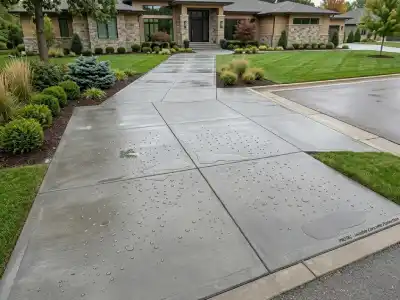
This is scaling: the slab's own surface skin lifting off, leaving a pitted, sandpapery grey patch. This is the one that matters. It is usually water that has soaked into an unsealed surface, frozen and pushed the skin off, helped along by de-icing salt. A surface that was overworked when it was laid, or sealed over bleed water, is more vulnerable to it from the start.
Isolated round pits with a chip in the middle
Pop-outs. A small particle just under the surface has swollen or expanded and blown a crater out. Cosmetic, isolated, and not a sign the rest of the slab is going.
Where it is happening tells you as much
- Along edges and in low spots — water sitting on the surface. Fix the water as well as the finish.
- In the wheel tracks — wear, or over-washing.
- Beside the road, the gate or a salted path — de-icing salt tracked onto the drive.
- Evenly across the whole surface — suspect how it was applied rather than how it has aged.
- Along a crack — water getting in through the crack. See which cracks in imprinted concrete matter.
What actually fixes it
A failed sealer is the straightforward one, but only if the loose film is properly taken off. New sealer laid over old sealer that is already letting go simply fails the same way, usually within a season. The surface has to be cleaned back, left to dry fully, and then resealed. That is the standard clean and reseal job, not a repair.
Worn colour is a recolour, because sealer cannot put pigment back.
Scaling is different, and this is where honesty matters. Sealing over a scaled patch does not stop it. A sealer slows water getting in; it does not rebuild a surface that has already lifted. A shallow, localised patch can be cleaned, made good, recoloured and sealed so it stops getting worse. Widespread or loose scaling means the surface of the slab is failing, and the honest answer is that it needs assessing in person before anyone prices it.
Resurfacing and refinishing
Both words turn up in searches. For imprinted concrete they usually mean one of two things. A recolour is a new pigmented coat over the existing surface, then sealed. A thin overlay is a different system laid over a sound slab. Neither is a cure for a surface that is still scaling, because the new layer simply goes on top of the weak skin and lifts with it. The cause has to be dealt with first.
Stopping it coming back
- Reseal on a cycle rather than waiting for it to fail. See how often to reseal imprinted concrete.
- Use grit or sand in icy weather, not rock salt. Fertilisers and de-icers containing ammonium compounds are particularly hard on concrete and best kept off it entirely.
- Keep the water moving. Clear drains and gullies, and do not let a downpipe discharge across the surface.
- Keep the jet wash away from it unless it is set up for the job. Most scaling we are asked about started with a turbo nozzle.
Common questions
- Why is my imprinted concrete peeling?
- Thin, clear or milky flakes are the sealer lifting, usually because it was applied over a damp or dirty surface or over an old failing coat. The concrete underneath is normally sound.
- Can I just reseal over flaking concrete?
- Not safely. Loose sealer has to come off first, and sealing over scaled concrete does not stop the surface lifting. The cause has to be dealt with before anything goes on top.
- What is scaling on imprinted concrete?
- The thin surface skin of the slab lifting off in small patches, usually after water and frost get into an unsealed surface, often helped along by de-icing salt. It leaves a rough grey patch.