Imprinted concrete or block paving? How to tell what you have
5 min read Concrete Revive
Stamped concrete is deliberately made to look like block paving, and plenty of owners genuinely do not know which they own. The maintenance is completely different.
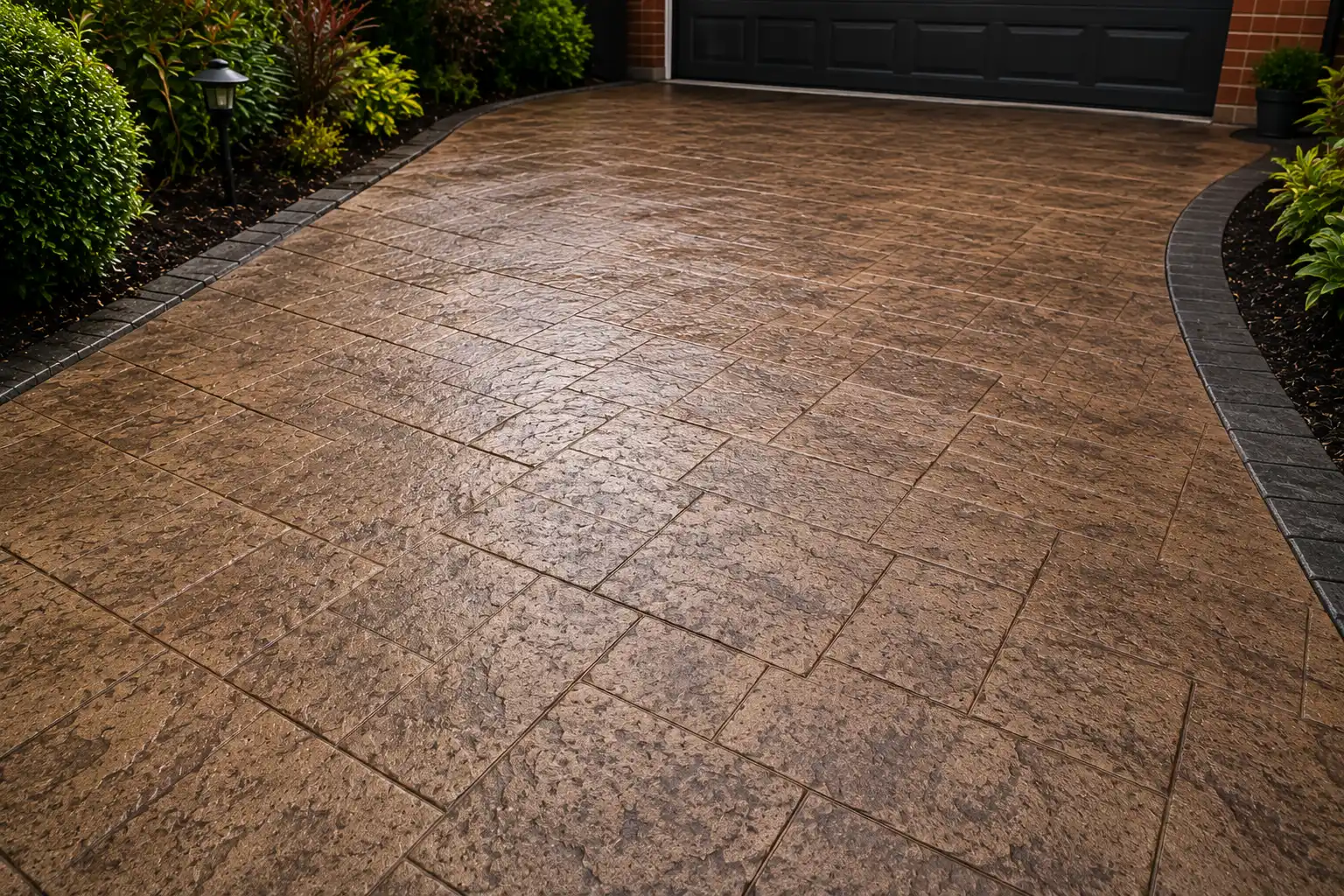
Pattern imprinted concrete is frequently stamped in a brick or block pattern, for the straightforward reason that people like how block paving looks. Done well, it is convincing enough that owners are sometimes unsure what they have — and since the two are maintained in almost opposite ways, it is worth knowing.
Four checks
1. Look at the joints
The clearest tell. Block paving has real gaps between individual units, filled with kiln-dried sand. Push a key or a screwdriver into a joint: on block paving it goes in and brings sand out. On imprinted concrete the "joint" is a groove pressed into one continuous slab, and nothing goes in.
2. Look along the surface at eye level
Crouch down and sight across it. Block paving has slight height variation between units — individual blocks sit fractionally proud or low. Imprinted concrete is one pour, so the surface follows a single continuous plane even where the pattern suggests otherwise.
3. Look at the edges and obstacles
Where the surface meets a manhole, a gully or a curve, block paving needs cut units, and you can see the cuts. Imprinted concrete flows around obstacles in one piece, and the stamped pattern often runs straight through where real blocks would have had to be cut.
4. Look for repeats
Stamps are mats, and mats repeat. Scan a large area and you can often spot the same arrangement of "stones" recurring at regular intervals. Real block paving is laid unit by unit and does not repeat that way.
Why it changes what you should do
Block paving depends on its joints. The sand between units is structural — it holds everything in interlock. Cleaning without re-sanding afterwards strips that out and causes blocks to rock and edges to spread. Weeds germinate in contaminated joint sand. The fix is cleaning, treating, and refilling the joints.
Imprinted concrete has no joints to lose. Its vulnerability is the sealer on top and the thin colour hardener beneath it. Nothing needs re-sanding; what it needs is resealing every three to five years. High-pressure cleaning erodes the colour layer, and once that is gone, sealing will not bring it back.
So the same well-meaning advice — "give it a good jet wash and re-sand it" — is right for one and actively harmful to the other.
If you are still not sure
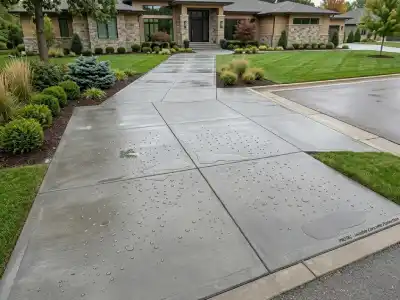
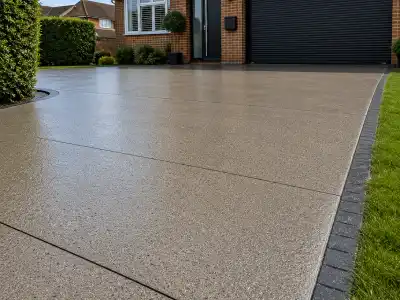
Two more clues. Imprinted concrete almost always has a visible expansion or crack-control joint cut into it somewhere, often a straight saw line that ignores the stamped pattern entirely. And block paving usually has a distinct edging course, frequently in a contrasting colour, holding the field of blocks in.
Failing that, ask us. It takes seconds to establish on site, and it is the first thing we check before quoting — because quoting the wrong process for the surface is how drives get damaged.
Common questions
- Does imprinted concrete need re-sanding like block paving?
- No. It is a single continuous slab with pressed grooves rather than real joints, so there is no sand to replace. It needs resealing instead.
- Can you jet wash imprinted concrete like block paving?
- Not at the same pressure. High-pressure washing erodes the colour hardener, and once the exposed grey concrete shows through, sealing will not restore the colour.
- What is the quickest way to tell them apart?
- Try to push something into a joint. Block paving joints are real and filled with sand; imprinted concrete grooves are solid.